
Pandavas in Bengal:
The Hidden Eastern Footprints of the Mahabharata 🐘📜
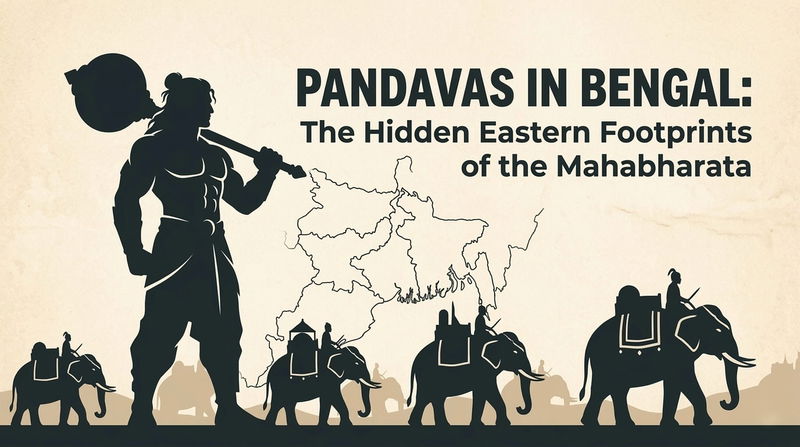

Although the central events of the Mahabharata unfold in northern India around the Kuru kingdom—roughly the region of present-day Delhi and Haryana—the Pandavas are also connected in intriguing ways to the Bengal region. In ancient times, this area was known by names such as Vanga, Pundra, Suhma, and Gauda. These links appear not only in the Sanskrit epic itself but also in long-standing Bengali folklore and regional traditions.
Bhima’s Eastern Campaign During the Rājasūya Yajna
One of the clearest connections appears during preparations for Yudhishthira’s Rajasuya Yajna, the royal sacrifice meant to establish him as a universal emperor. To assert his authority, Yudhishthira sent each of his brothers to conquer different directions of the subcontinent and collect tribute from regional kings.
Bhima was assigned the eastern campaign. According to the Mahabharata, he marched through several eastern kingdoms and defeated the rulers of Pundra (northern Bengal), Suhma (the Rarh region of western Bengal), and Vanga (southern or eastern Bengal). These victories brought enormous wealth to Indraprastha. The kings of Vanga were especially famous for their powerful war elephants, and Bhima returned with large numbers of these prized animals as tribute.
The Slaying of Bakasura at Ekachakra
Another tradition linking the Pandavas to Bengal centers on the story of Bakasura. After escaping the burning Lakshagriha palace, the Pandavas and their mother Kunti lived in disguise as Brahmins in a town called Ekachakra.
In many Bengali traditions—especially within Gaudiya Vaishnavism—Ekachakra is identified with a village in present-day Birbhum district of West Bengal. According to the legend, the town’s residents lived in constant fear of a ravenous demon named Bakasura, who demanded a daily cart of food along with a human victim. When Kunti learned of their suffering, she sent Bhima in place of the chosen victim. Bhima confronted the demon, engaged him in a fierce struggle, and ultimately killed him, freeing the village from terror.
The Forest of Hidimbi in Western Bengal Folklore
Earlier in their wanderings, before arriving at Ekachakra, the Pandavas traveled through dense forests. Here Bhima fought the demon Hidimba and later married his sister Hidimbi, who became the mother of their powerful son Ghatotkacha.
Some local traditions in western Bengal, particularly around the Midnapore and Kharagpur regions, connect these forests to the broader Chota Nagpur plateau and the Santhal Parganas. Near Kharagpur, a temple known as the Hirimbeshwari Temple in Inda is associated with local legends claiming the tribal princess Hidimbi once worshipped there.
Bengal Kingdoms in the Kurukshetra War
When the Kurukshetra War finally erupted, the kingdoms of eastern India were drawn into the conflict and had to choose sides.
The king of Vanga joined the Kaurava alliance, bringing formidable forces that included war elephants and skilled fighters experienced in riverine and coastal warfare. These eastern troops often fought alongside powerful allies like Bhagadatta, the king of Pragjyotisha (in present-day Assam), whose kingdom bordered the Bengal region.
A Living Epic Across Regions
Although the Mahabharata originated in northern India, its stories spread widely across the subcontinent over centuries. As the epic traveled, regions like Bengal wove the narrative into their own landscapes and traditions. Through folklore, local temples, and regional interpretations, the Pandavas became part of Bengal’s cultural memory, linking the epic’s grand narrative with eastern India's geography and history.

Comments
No comments yet. Be the first to comment!